


Product Introduction
The ECNITY 133mm DC low noise centrifugal blower fan focus on lightweight construction and installation flexibility. Motors and impellers are often of split design, with impeller materials selected based on application needs (plastic or aluminum alloy). The compact housing supports horizontal or vertical installation, adapting to various mounting orientations. Both types utilize symmetrical volute casings to efficiently guide airflow and reduce recirculation losses.
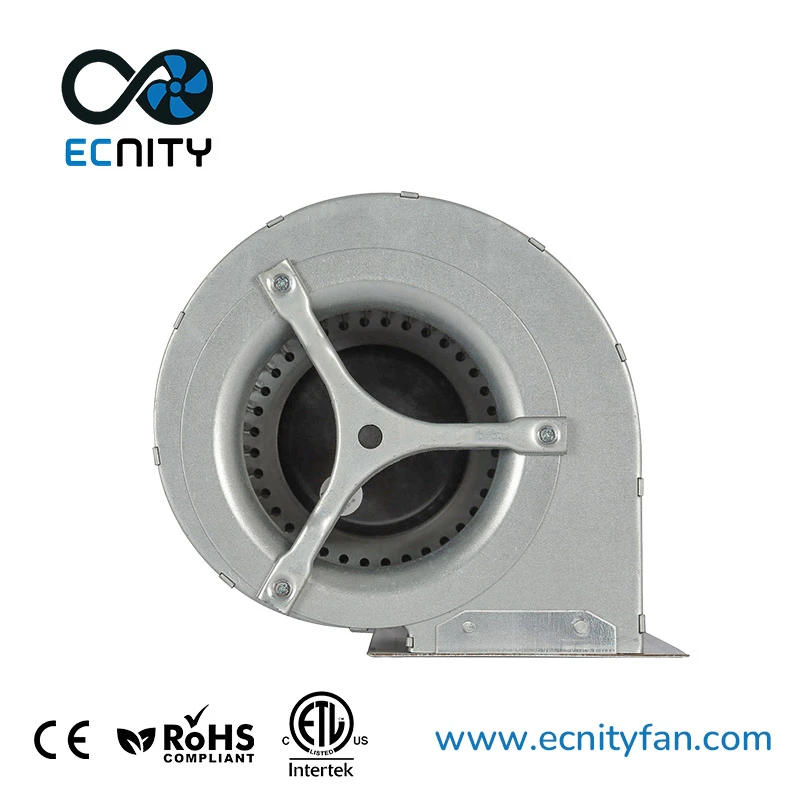
133mm DC low noise centrifugal blower fan technical parameters:
|
Model No. |
Rated |
Operation Voltage |
Rated |
Rated |
Rated |
Air Flow |
Air |
Noise |
|
VDC |
VDC |
A |
W |
RPM |
m3/h |
Pa |
dBA |
|
|
EN-D133-H190-D024-B01 |
24 |
18~32 |
6.00 |
144 |
1780 |
750 |
500 |
62 |
|
EN-D133-H190-D048-B01 |
48 |
36~57 |
3.00 |
144 |
1780 |
750 |
500 |
62 |
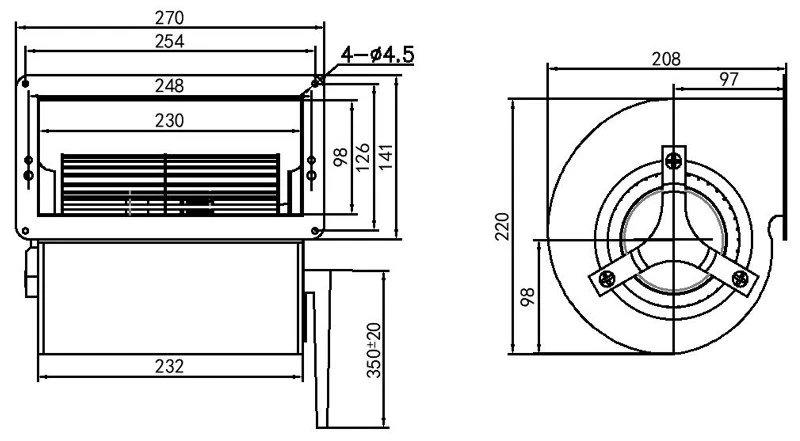
Outline Drawing:
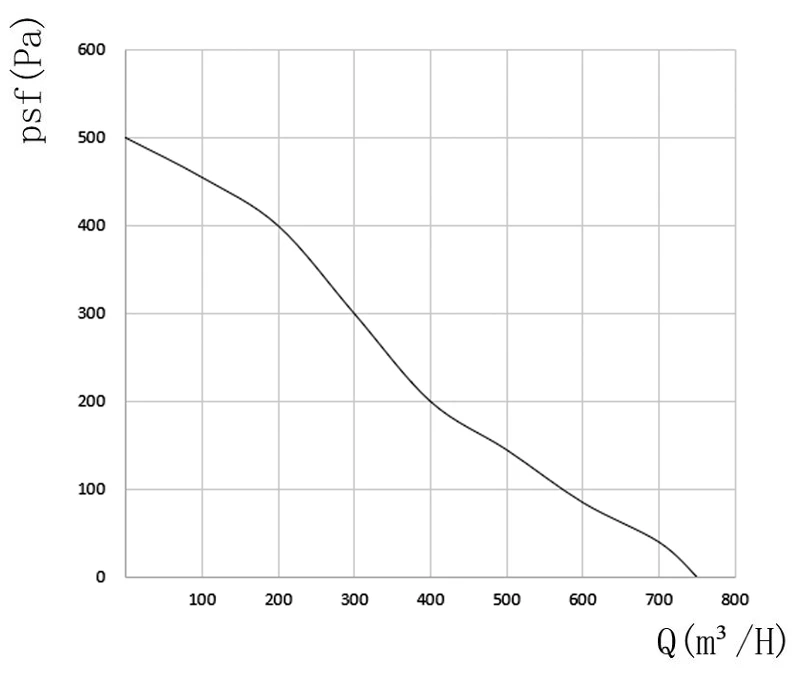
Performance Curve
Connection
|
DC Wire |
AC Wire |
||
|
Color |
Function |
Color |
Function |
|
Red |
+10VDC |
Brown |
L |
|
Blue |
GND |
Blue |
N |
|
Yellow |
0~10VDC/PWM |
Green/Yellow |
PE |
|
White |
FG |
||
Control capability is one of the most significant differences between EC and DC double inlet centrifugal blowers. EC models integrate intelligent control units supporting constant speed, constant airflow, and constant torque modes. They can be linked with Building Automation Systems (BAS) and environmental monitoring platforms for remote monitoring, fault alarms, and automatic start/stop functions. High-end models incorporate temperature and speed sensors for real-time feedback and enhanced control accuracy.
The ECNITY 133mm DC low noise centrifugal blower fan offer more basic control. Brushless DC models typically support simple PWM speed control, while brushed models operate at fixed or stepped speeds. Complex intelligent integration is generally not supported, and commissioning relies on manual voltage or current adjustment. These characteristics make DC models suitable for applications with limited automation requirements and tighter budgets.
The ECNITY 133mm DC low noise centrifugal blower fans are more common in small and mid-sized residential or commercial applications, prioritizing lightweight and cost efficiency. Volutes are usually plastic or thin steel, while impellers are made from PBT reinforced with 30% glass fiber, providing flame retardancy, moisture resistance, and stable operation across –40°C to 75°C.

Our factory


FAQ
1. What are common causes of EC fan failure?
Common causes include improper installation, electrical issues, and harsh operating conditions. Overloading beyond specifications can also affect performance. Regular inspection helps identify potential risks. Correct application reduces failure probability.
2. How does EC technology improve operational stability?
EC technology allows precise control of motor speed and torque. Smooth startup reduces mechanical stress. Integrated monitoring protects against abnormal conditions. This improves overall operational stability.
3. Can EC fans be monitored during operation?
EC fans can be monitored through control signals and system feedback. Monitoring helps track operating status. Integration with automation systems improves visibility. Monitoring supports preventive maintenance.
4. Are EC centrifugal fans suitable for high-usage environments?
EC centrifugal fans are suitable for high-usage environments. Efficient motor design reduces heat buildup. Continuous operation is supported when within specifications. Proper cooling and installation are important.
5. How do EC fans compare to AC fans in terms of reliability?
EC fans generally offer improved reliability due to reduced mechanical wear. Integrated electronics manage motor performance effectively. AC fans may require additional components for control. EC fans simplify system design and reduce failure points.