


Axial Fan
Your Professional Axial Fan Supplier
ECNITY is a professional manufacturer specializing in EC motors and fan solutions for HVAC and industrial applications. With years of experience in motor production, fan assembly, and system optimization, we provide energy-efficient centrifugal and axial fans for OEM manufacturers and system integrators worldwide. Our products are widely used in ventilation, air conditioning, cooling, and industrial airflow systems.
Customized Solutions
We offer flexible OEM and ODM support for airflow, pressure, motor control, and structural design. Each project is adjusted to match different applications and customer needs.
Quality Control
Our manufacturing covers the full production process, including motor assembly, impeller balancing, fan assembly, and testing. Strict quality control helps ensure product consistency and long-term reliability.
Professional Service
Effective technical communication improves project efficiency. Our engineering team works closely with customers to reduce development risks, shorten lead times, and support long-term cooperation.


Parameter
|
Impeller Diameter |
200mm |
|
Impeller Material |
Steel and coated in black |
|
Direction of Rotation |
CW, see on rotor |
|
Speed Control |
0-10VDC/PWM |
|
Type of Protection |
IP44 / IP54 |
|
Insulation Class |
B |
|
Operation Mode |
S1 |
|
Ambient Temperature |
-25~+60℃ |
Types of Axial Fan
The axial fan produced by our company mainly include the following types:
EC Axial Fan
EC Axial Fans, fully known as Electronically Commutated Axial Fans, are a new generation of ventilation devices that integrate advanced electronic control technology with permanent magnet synchronous motors.
DC Axial Fan
DC axial flow fan, fully referred to as Direct Current Axial Fans, are ventilation devices driven by direct current power, with airflow moving along the axial direction.

Advantages of Axial Fan
High airflow efficiency
Axial fans are designed to move large volumes of air in a straight line, parallel to the fan's axis. Axial flow fans generate a significant amount of airflow, making them efficient for applications where high airflow rates are required.


Compact design
Axial fans have a relatively simple and compact design compared to other types of fans, such as centrifugal fans. This makes them suitable for installations where space is limited as axial fan sizes have a smaller desired footprint.
Cost-effective
An axial fan price is generally more cost-effective compared to other fan types. They are simpler to manufacture and require fewer components, resulting in lower production costs. This affordability makes them a popular choice in many industries.

Versatility
Axial fans can be found in a wide range of sizes, from small desktop fans to large industrial fans. They can be used in various applications, including ventilation systems, cooling electronic components, air circulation in HVAC systems, and cooling machinery or processes.
Low power consumption
Axial fans typically consume less power compared to other types of fans. This energy efficiency makes them economical to operate and can result in energy savings over the long term.

Easy installation and maintenance
Due to their simple design and fewer components, axial fans are relatively easy to install and maintain. They are often designed for easy access to the fan blades, allowing for cleaning or maintenance tasks without major disassembly.

Applications of Axial Fan
HVAC Systems: Axial fans are widely used in heating, ventilation, and air conditioning (HVAC) systems to circulate air within buildings, regulate temperatures, and maintain indoor air quality.
Industrial Ventilation: They are used for general ventilation in industrial settings to remove fumes, smoke, or other airborne contaminants from the work environment.
Cooling Electronic Equipment: Axial fans are often used to cool electronic equipment such as computers, servers, and electronics cabinets. They help dissipate heat generated by these devices to prevent overheating and maintain optimal operating conditions.
Agricultural Applications: Axial fans are used in agriculture for ventilation in livestock barns, greenhouses, and storage facilities. They help control humidity, temperature, and air quality.
Industrial Processes: Many industrial processes require proper ventilation to maintain safe and efficient operations. industrial Axial fans can be used to control air movement and remove pollutants or fumes generated during manufacturing processes.
Mining and Tunnel Ventilation: In mining and tunneling operations, axial fans are used to provide adequate ventilation for worker safety by removing dust, gases, and providing fresh air.
Sports Arenas and Large Facilities: In large venues like sports arenas, convention centres, and warehouses, axial fans help ensure proper air circulation and temperature control for the comfort of occupants.
Refrigeration Systems
Some refrigeration systems utilize axial fans to circulate air through the evaporator coils, facilitating the heat exchange process and cooling the refrigerated space.
Power Generation
Axial fans can be used in power plants for cooling purposes, particularly in steam turbine condensers where they help condense the steam back into water.
Exhaust Fans
These fans can be used in various applications where exhaust air needs to be removed, such as kitchen exhaust systems, bathroom ventilation, and more.
Wind Tunnels
In aerodynamic testing facilities, axial fans are used to simulate wind conditions, helping engineers and researchers understand the effects of airflows on various objects.
Comparison Between Axial Fans And Centrifugal Fans
|
Feature |
Axial fan |
Centrifugal fan |
|
Airflow direction |
Straight-through (parallel to shaft) |
90° angle (radial discharge) |
|
How air moves |
Air is drawn in line with the shaft and propelled outward in the same direction |
Air is moved radially thanks to centrifugal force generated by the impeller |
|
Air volume |
Higher (large volumes) |
Lower vs axial at same size (more focused) |
|
Max flow rate |
Up to 830,000 m³/h |
Up to 500,000 m³/h |
|
Pressure capability |
Lower |
Higher |
|
Max static pressure |
Up to 5,000 Pa |
Up to 25,000 Pa |
|
Best performance |
High airflow in low pressure conditions |
Higher pressure airflow against resistance |
|
Typical use cases |
Ideal when low-pressure, large volumes of clean air must be moved |
Effective in systems like filtration, ducts, dust/fume extraction |
|
Size/weight |
More compact and with a simpler structure |
Heavier construction and more complex structure |
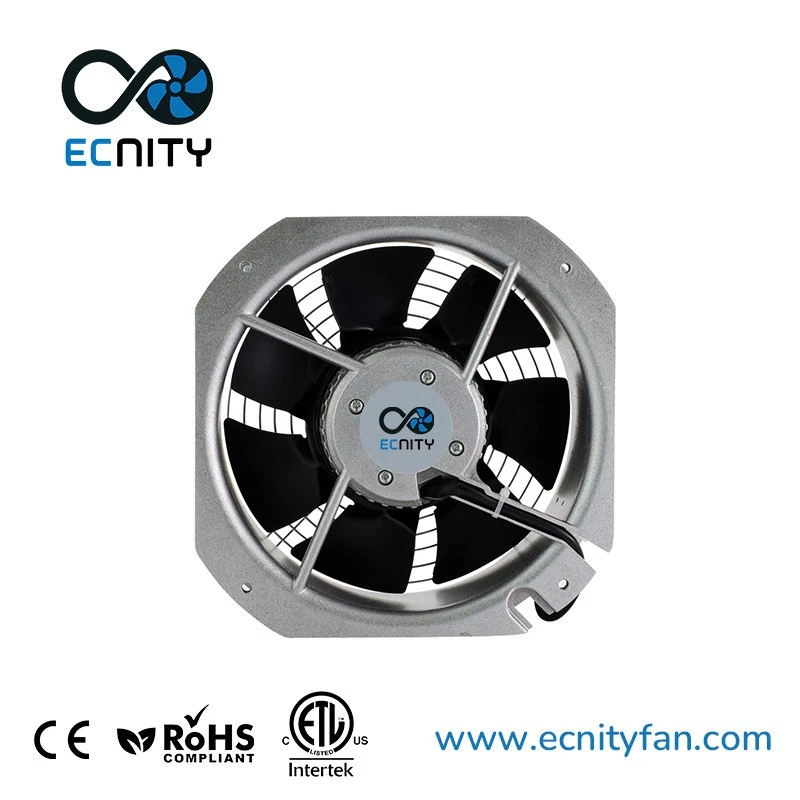
Blades: Central to an axial fan's functionality is the fan blades (or ‘impeller’). These blades can vary in number and are intricately designed with aerodynamic profiles to maximise airflow efficiency.
Hub: The hub serves as the core of the fan, anchoring the blades. It links the blades to the shaft, ensuring they are correctly aligned and stable during operation.
Shaft: The shaft is a pivotal mechanical element that connects the impeller to the fan's motor. As the motor energises the shaft, it rotates the impeller, thus generating a stable and continuous airflow.
Motor: The motor supplies the mechanical power needed to operate the axial fan. Depending on their specific applications, axial fans can utilise various power sources, including electric motors, internal combustion engines, or alternative energy sources.
Casing: The casing encloses the fan blades and the motor, helping to channel the airflow efficiently while safeguarding the fan’s internal components. This structural element enhances the axial fan's overall performance and durability.
Customizable Options
|
Fan Size |
40mm / 60mm / 80mm / 120mm / 200mm / Custom |
|
Voltage |
5V / 12V / 24V / 48V / 110V / 220V |
|
Power Range |
2W – 500W |
|
Speed |
800 – 6000 RPM |
|
Blade Material |
Plastic / Aluminum / Steel |
|
Frame Material |
PBT / Aluminum Alloy / Metal |
|
Bearing Type |
Sleeve Bearing / Ball Bearing / Hydraulic Bearing |
|
Motor Type |
AC Motor / DC Motor / EC Motor |
|
Blade Design |
5 Blade / 7 Blade / High Pressure Blade |
Ordering Process
Inquiry - quotation - communication - order confirming - deposit payment - production - testing and debugging - balance payment - packing - delivery - customer receiving - after service.
Packaging and Shipping
|
Packaging |
Cardboard boxes, wooden crates |
|
Shipping |
Shipping by sea, by air, by express are acceptable. According to your requirements. |
Our Factory


FAQ
As one of the most experienced axial fan manufacturers and suppliers in China, we offer a wide range of products with superior quality. Please feel free to buy high-grade axial fan made in China here from our factory. We also accept customized orders.