


Product Introduction
The aerodynamic design of ECNITY EC backward external centrifugal fan is optimized through professional computational fluid dynamics (CFD) simulation. The inclination angle and curvature of the backward blades are carefully engineered to guide airflow smoothly through the impeller. Air enters axially and is discharged radially, ensuring smooth airflow with minimal resistance.
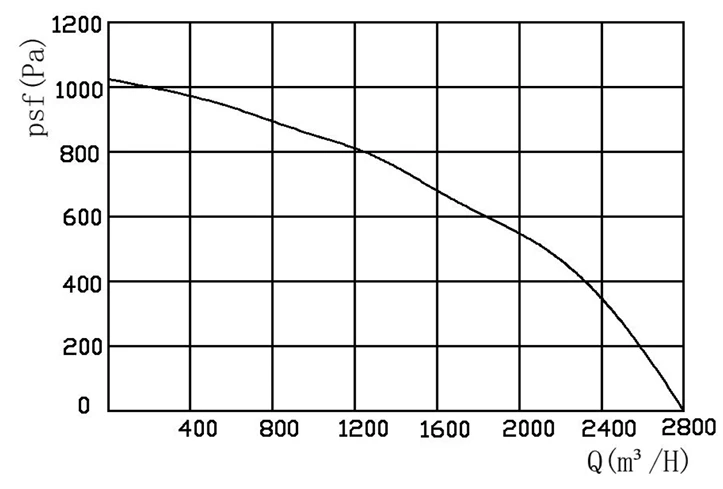
The total pressure of the fan is composed of static pressure and dynamic pressure. By optimizing the impeller structure, the fan maintains stable airflow output even under high static pressure conditions, making it ideal for applications with complex duct systems and air filtration equipment that require overcoming high airflow resistance.
Additionally, the airflow output is uniform and stable, with minimal fluctuations. This prevents localized under-ventilation or excessive airflow, ensuring consistent ventilation performance. Such characteristics make the fan highly suitable for environments that demand uniform airflow distribution, such as cleanrooms, laboratories, and biomedical facilities.

EC backward external centrifugal fan technical parameters:
|
Model No. |
Rated |
Operation Voltage |
Frequency |
Rated |
Rated Power |
Rated |
Air Flow |
Air |
Noise |
|
VAC |
VAC |
Hz |
A |
W |
RPM |
m3/h |
Pa |
dBA |
|
|
EN-B310-H068-E115-C01 |
115 |
90~135 |
50/60 |
3.40 |
390 |
2620 |
2800 |
1050 |
78 |
|
EN-B310-H068-E230-C01 |
230 |
184~274 |
50/60 |
1.70 |
390 |
2620 |
2800 |
1050 |
78 |
|
EN-B310-H068-E380-C01 |
380 |
310~460 |
50/60 |
1.05 |
390 |
2620 |
2800 |
1050 |
78 |
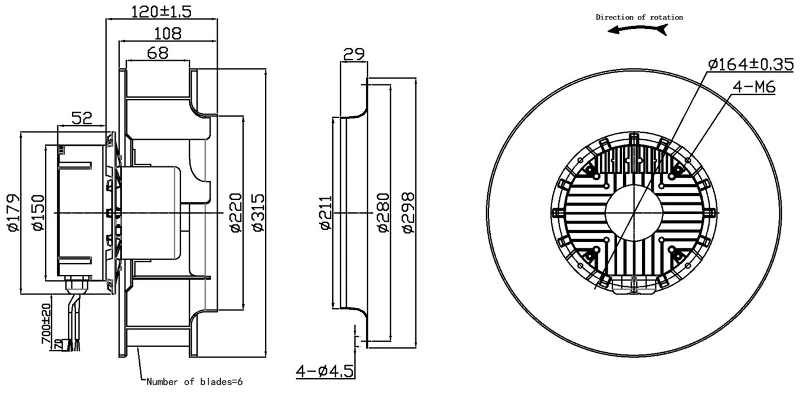
Outline Drawing:
Performance Curve
Connection
|
DC Wire |
AC Wire |
||
|
Color |
Function |
Color |
Function |
|
Red |
+10VDC |
Brown |
L |
|
Blue |
GND |
Blue |
N |
|
Yellow |
0~10VDC/PWM |
Green/Yellow |
PE |
|
White |
FG |
||
The EC motor used in EC backward external centrifugal fans adopts an external rotor design, which provides a compact structure and higher energy transmission efficiency. In this design, the motor rotor directly drives the impeller, reducing transmission losses caused by intermediate mechanical components.
This configuration significantly improves energy efficiency while reducing the overall size of the fan, allowing installation in space-constrained environments.
The rotor surface is treated with powder coating, providing excellent corrosion resistance and long-term durability. At the same time, the external rotor structure offers superior heat dissipation performance, allowing heat generated by the motor to dissipate quickly into the surrounding environment, preventing overheating.
The motor also utilizes high-quality ball bearings with low friction coefficients and long service life. These bearings require minimal lubrication maintenance, making the fan suitable for continuous long-term operation, such as in data centers and industrial production facilities.

Our factory


FAQ
1. What should be done if an EC fan does not start?
Power supply and control signals should be checked first. Wiring connections should be verified. Protection functions may prevent startup under fault conditions. Troubleshooting should follow the manufacturer's guidelines.
2. Can EC centrifugal fans operate continuously at maximum speed?
EC fans can operate at maximum speed within specified limits. Continuous operation at full load should be evaluated based on application. Adequate cooling is important. Operating within design limits ensures reliability.
3. Can EC centrifugal fans restart automatically after a power failure?
Many EC fans can restart automatically after power is restored. Restart behavior depends on controller settings. This feature is useful for unattended systems. Restart characteristics should be confirmed for each model.
4. How should airflow direction be verified during installation?
Airflow direction should match system design requirements. The fan housing or documentation usually indicates airflow direction. Incorrect direction can reduce performance. Verification should be done before final installation.
5. How does this EC fan improve system competitiveness?
High efficiency and controllability improve system performance. Reduced operating costs enhance competitiveness. Reliable operation supports long-term project success. These factors add value to the overall system.